

The Good Stuff #29
Everything I read on our mini holiday. Best novels lists. The return of Rivals. Memoirs that misremember? A dream house in France.

Adieu May - my birthday month and the one in which we went away for all of three-and-a-bit days, but it very much counted as it coincided with the heatwave, so Dorset felt more like Greece - complete with violet jellyfish, floating ominously near the shoreline.
I am very fond of Thomas Hardy’s Dorset landscape "Behind him the hills are open, the sun blazes down upon fields so large as to give unenclosed character to the landscape, the lanes are white, the hedges low and plashed, the atmosphere colourless.” It reminds me of my sixth form English teacher, the very passionate - about literature, keep your hair on - Mr P, who introduced me to Hardy’s poetry. (‘The Voice’ remains one of my favourite poems.)
Books featured heavily. The cottage we were staying in was opposite a phonebox library - I liberated a Georgette Heyer and Robert Harris’s Conclave. We went to Bridport, and I found a biography of Rumer Godden (A Time to Dance, No Time to Weep) in Wild and Homeless Books. Next door but one is The Bridport Bookshop. Now, you might not be aware of it, but there is an unwritten rule of the gods that you must buy a book when in an independent bookshop. (“I like your god,” commented the nice lady behind the till when she overheard me telling my children about this law.) I bought us a book apiece: Our Infinite Fates by Laura Steven (for my daughter); The Galileo Heist by Sam Sedgman (for my son); The Warrior, a biography of Rafael Nadak for my husband; Sarah Moss’s Ripeness (for me, because otherwise I would have felt terribly left out).
My holiday reading was exceptional. Buckle in for a round-up.
Housekeeping note: this post is epic in length so you may have to click through to read it in its entirety. I’d love you to be a regular around these parts - or, should you feel so minded, to upgrade to a paid subscription and support my writing, then I shall be a very grateful, very happy woman indeed

Almost Life - Kiran Millwood Hargrave (Pan Macmillan)
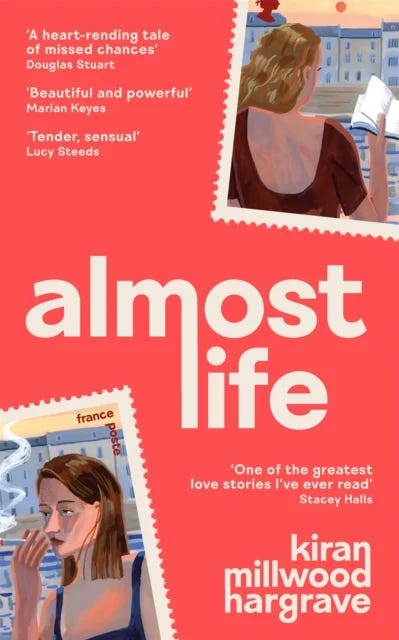
In 1978, gauche English tourist Erica is in Paris, searching for whatever it is that you look for in Paris when you are are young, gorgeous and naïve. What - or rather who - she finds is Laura, a louche, bohemian, older Parisian, reading on the steps to Sacré-Cœur. It is a (it feels suitable to say in the circumstances) a coup de foudre.
What ensues is a will-they-won’t-they-should-they love story that unspools over decades, like a queer One Day. Erica leaves Paris and their “perfect summer” and returns to Norfolk, studies creative writing, falls for and marries the conventionally handsome, rich, and talented Ant (not a villain - but a man who knows there are parts of his wife which are withheld). But the lure of Laure is too strong, and the two are drawn back together - their love and yearning span the years. Both women struggle with demons (neither are perfect), both are haunted by the paths taken - and those untrod. Erica plays “versions of her life on fast forward, staying, not staying”.
It plays out against the backdrop of gay rights - one of the most engaging characters is Laure’s best friend, Michel, who is nursed devotedly through his final illness (AIDS, they realise late in the day, as it becomes part of the public consciousness), by his chosen family. But the thwarted, aching love between the two women is the beating heart of this deeply evocative, tender and sensual novel. A love story for the age which will tear your heart asunder.
The Shampoo Effect - Jenny Jackson (Hutchinson Heinemann)
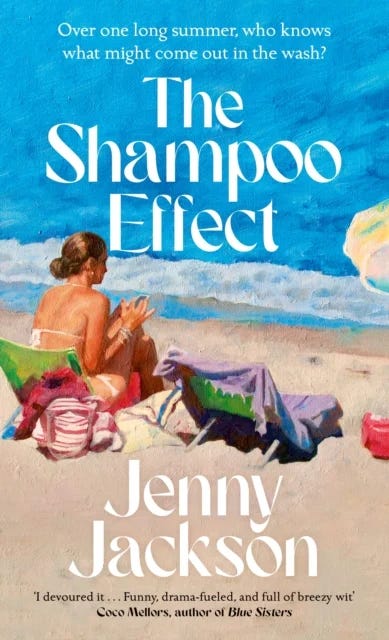
I loved Pineapple Street and this is just as much of a delight. Jenny Jackson excels at breezy charm (her books are devourable), but has a sharp, unerring eye for the dynamics of friendships and relationships. This is a wonderfully astute portrait of motherhood, marriage, and learning how to be a decent grown up (even though it’s far more fun to negate the responsibility and hark back to the good old days). But it’s such terrifically good fun, you don’t realise quite how clever it is at the time of reading - you’re too busy enjoying the ride.
Young, fledgling writer Charlotte Lash is hampered by her nepobaby status (her mother is a famous and successful author) but is chasing the dream after she has a short story published in The New Yorker, and wins a writing fellowship in Greenhead, an idyllic corner of New England. She promptly falls for the adorably earnest, pure-of-heart Van Whittaker (this is a truly perfect name for an intense American chap), and is plunged into his friendship group. They have, naturally, been friends since school, know (nearly) all each other’s secrets, and have an ease calculated to make a newcomer ill at ease. Especially when Caroline discovers that Bailey, Van Whittaker’s on/off and entirely gorgeous ex, is pregnant with his baby.
Undeterred - or perhaps just determined? - Caroline hangs out them on boats, at beach picnics, at parties. Oh, the delicious awkwardness of people behaving badly and the group dynamic being thrown off by the interloper. Soon, it’s all unravelling and the drama unfolds. The story shifts between the cast of characters, but Jackson is so good at voice, it’s It’s perceptive, witty, astute and I insist you take it on your holiday this summer.
Tenderness - Rowan Beaird (Manilla Press)
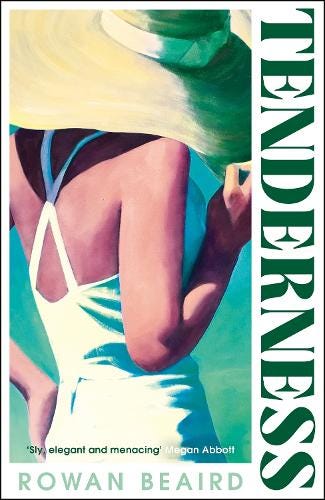
Family and friends gather on an island off the coast of Virginia for the marriage of beautiful, clever Shay and Andrew, scion to a wealthy family. Amongst the habitual awkwardness of forced proximity, there are covert mutterings about the bride - who has recently escaped the clutches of a bizarre, and possibly dangerous cult. Or has she? There are figures in the shadows and strange happenings. The atmosphere is oppressive and riven with tension - and Beaird turns the screw, not via things going bump in the night, but via the three narrators: William, Shay’s vulnerable brother, Joel, her ex (who is at the wedding with his girlfriend, but still harbours a church’s worth of flames for Shay), and Shay herself. It’s headily intoxicating - more character study than thriller, and it probes grief, trauma, accountability, and the choices we make to protect those we love - and ourselves.
Ripeness - Sarah Moss (Picador)
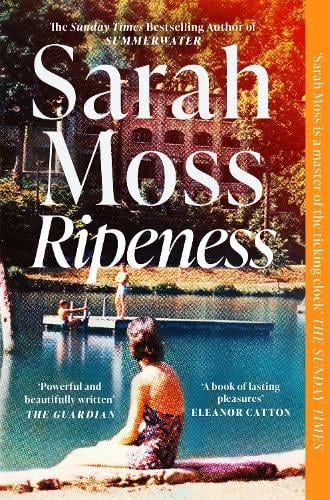
Edith is a septuagenarian living in Ireland - comfortably off, happily divorced, satisfied (as the novel opens, she is in bed with a man with whom she is having a casual fling), and sustained by her close friendship with Méabh. In the 1960s, Edith was a bookishly earnest 17-year-old, she spent the summer before going to Oxford in Italy, despatched by her mother to look after her older sister, Lydia, a ballerina who is unmarried, pregnant with a child she is to give up for adoption once it is born. It is Edith who must help her sister through the birth, and make the call that decides the child’s fate.
Edith is confused, conflicted, Lydia plans to dance the Sugar Plum Fairy at Christmas - although she refused an abortion, because the child is Jewish - and their mother survived the Holocaust but her mother and sister did not: “What kind of niece and granddaughter would I be if I got rid of a Jewish baby?”
The two strands run in tandem, colliding when a hitherto unknown older brother contacts Méabh, explaining that their mother had given him away to be adopted and now he wants to visit Ireland, to see where he comes from. It’s a sublime meditation on belonging, family, identity, displacement - at times almost unbearably tense - and unbearably tender.
Our Perfect Storm - Carley Fortune (Penguin Michael Joseph)
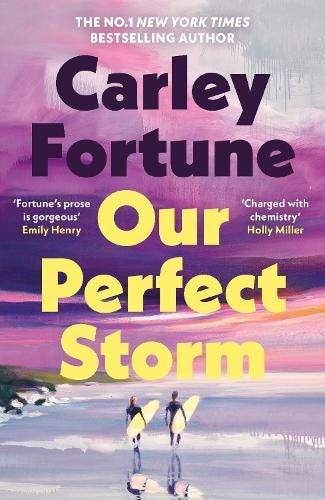
I’m tempted just to to write 10 out of 10, no notes. Carley Fortune is the queen of swoon-inducing love stories which have warmth, chemistry, and spectacular backdrops. You know where it’s going, but it’s the journey which matters - and no one does it like Carley.
Frankie and George are childhood best friends, then flat mates, who have - Frankie isn’t sure why - drifted apart. It’s the eve of her wedding and George is her best man - but will he show? He does - sing, choirs of angels - but the next morning, Frankie’s fiancé has vanished, leaving a note, saying he can’t marry her. George scoops her up and convinces her that the remedy for a broken heart - and perhaps to find herself - is to go on the honeymoon to Tofino. With him. As friends.
Look, there are no prizes but the sweetness and the chemistry and the manner in which this is not just a friends-to-lovers story, but one about a woman finding herself AND it’s littered with Little Women references (it’s Frankie and George’s lodestar novel - they even have a postbox through which they exchange letters and he is obviously Laurie, the boy next door who lives with his wealthy grandmother. Truly a book for everyone who still secretly thinks Jo and Laurie should have ended up together.
Whistler - Ann Patchett (Bloomsbury)
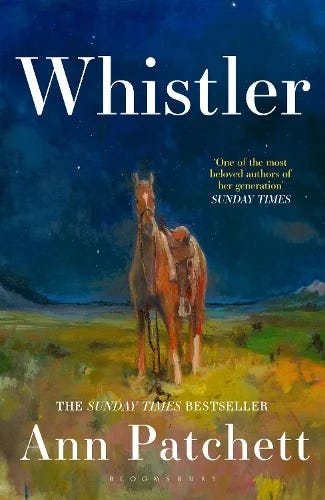
I need to write a post about this and the new Strout - so for now all I shall say is: read it and marvel.
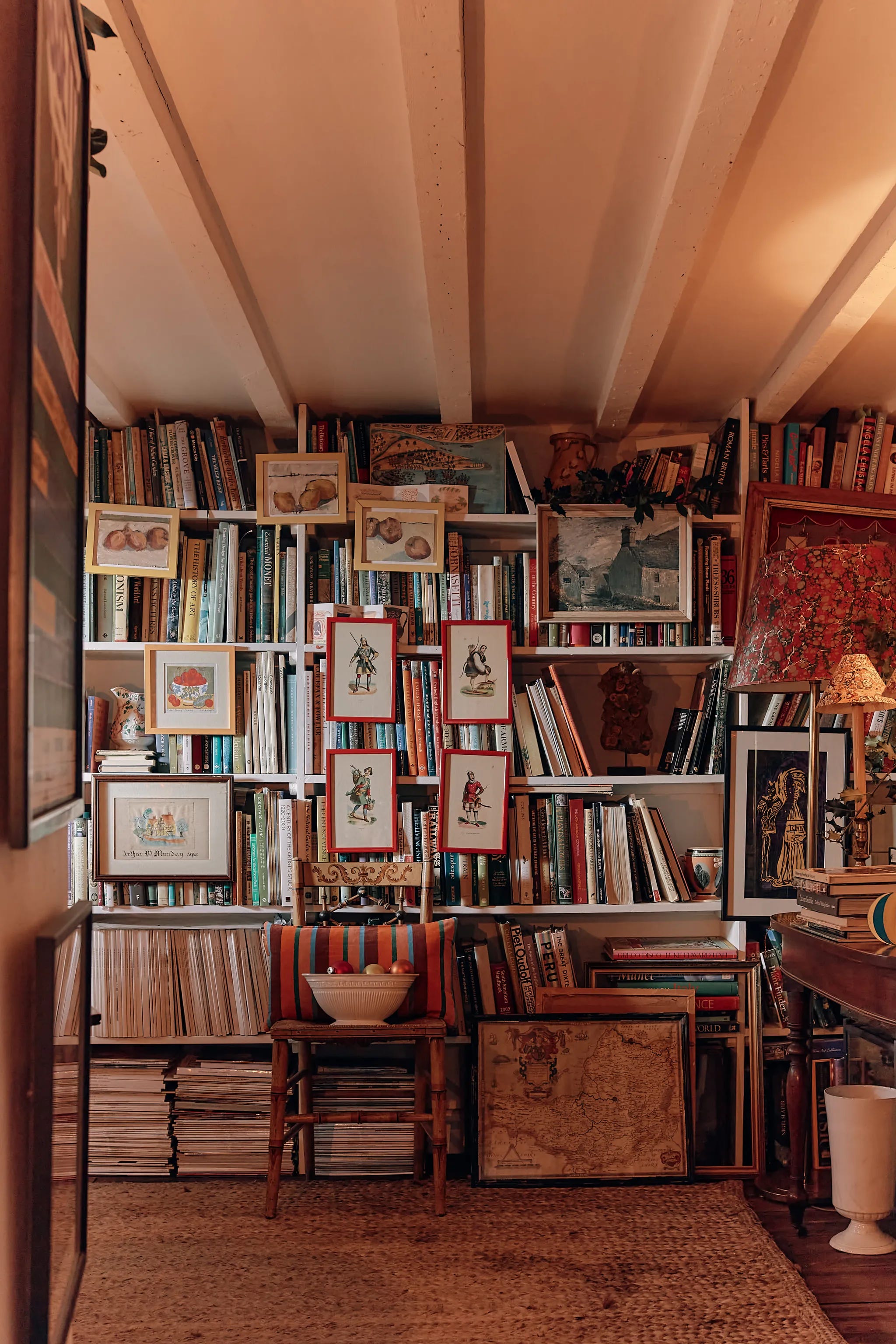
Divine higgledy piggledy bookshelves in Sean Anthony Pritchard’s cottage.
The Guardian published a list of the 100 best novels of all time. This is how they went about compiling it. I found the authors’ lists far more intriguing and varied than the actual list - which features only 36 female writers (Could Do Better) - although they do take 5 of the top 10 spots, including no. 1 (Middlemarch) and no. 2 (Beloved). (I can’t argue with those, although I have not read no. 3 Ulysses. I have tried, but I have not conquered it.) And I thoroughly enjoyed the ensuing discussions, especially Elizabeth Morris’s frank admission that the list irked her. Who, she demands, is the list really for? .
I was - am - obsessed with Belle Burden’s Strangers, her memoir of the breakdown of her marriage, which is being brought to the screen by Gwyneth Paltrow (who else?) It has become a cautionary tale for married women reneging financial control - even if we aren’t in the WASP-y 1%. Much hinges on the pre-nuptial agreement Belle’s lawyer advises her against, but she signs anyway. It states that income and investments made earned during their marriage remain separate unless placed in a joint name. Belle emptied her trusts to buy the family homes (a New York apartment; a house on Martha’s Vineyard), and given up work to facilitate her hedge fund husband’s meteoric rise - but now he can claim a share in the houses, whilst she has no access to his squillions.
Now The New Yorker reports that the memoir does not tell the whole story. Writer Jessica Winter has scrutinised the court documents and uses them to pick holes in Belle Burden’s account.
My first thought is: obviously it only tells part of the story. By its nature, memoir is partial and prejudiced. My second is: this feels a little like an echo of The Salt Path saga - not in the sense that Burden embellished or fabricated her account (as Raynor Winn is purported to have done), but more that you’d expect rather more rigorous fact-checking from the publisher. Amy Odell is very good on this.
Love AJ Pearce’s Notes of Cheer. She is a joy in your inbox.
Ann Patchett wants to make people ‘feel a little better about life’. Ann, you do. You absolutely do.
In a neat connection, Ann Patchett was an early champion of Virginia Evans’s The Correspondent - herewith the books that have shaped Virginia.
The Royal Society of Literature has launched a grant fund to donate £1m to promote literature in communities across the UK. (Literature is under-funded compared to other art forms.) Application can be made via the RSL website. Organisations who apply must be UK-based and primarily focused on literature, reading, or writing.
20 books for your forever collection thanks to sam baker and her guests.
Rivals has returned! I have watched three episodes thus far. I am delighted by: the French farce kitchen scene. The growing stature of Lady Monica Baddington (“That was embarrassing… For me.”) who is, I suspect, not a woman to be trifled with. Charles and Gerald - who is marrying the jolly hockey sticks but also jolly nice Muffy (“short for Caroline” in no world but Jilly’s) as a front, whilst his heart beats for Charles. The longing between Lizzie and Freddie. Oh, to be a potato waffle, that I may touch her hand. Lizzie’s husband James has achieved new heights of overweening vanity and staggeringly awful behaviour. (Did anyone else watch their marital relations with their hands clamped over their eyes in absolute horror?) “Why did you marry him?” Freddie asks. “Because he asked me.” Lizzie replies - the sadness of which sentence you do not appreciate at first, and then it wallops you, right in the heart.
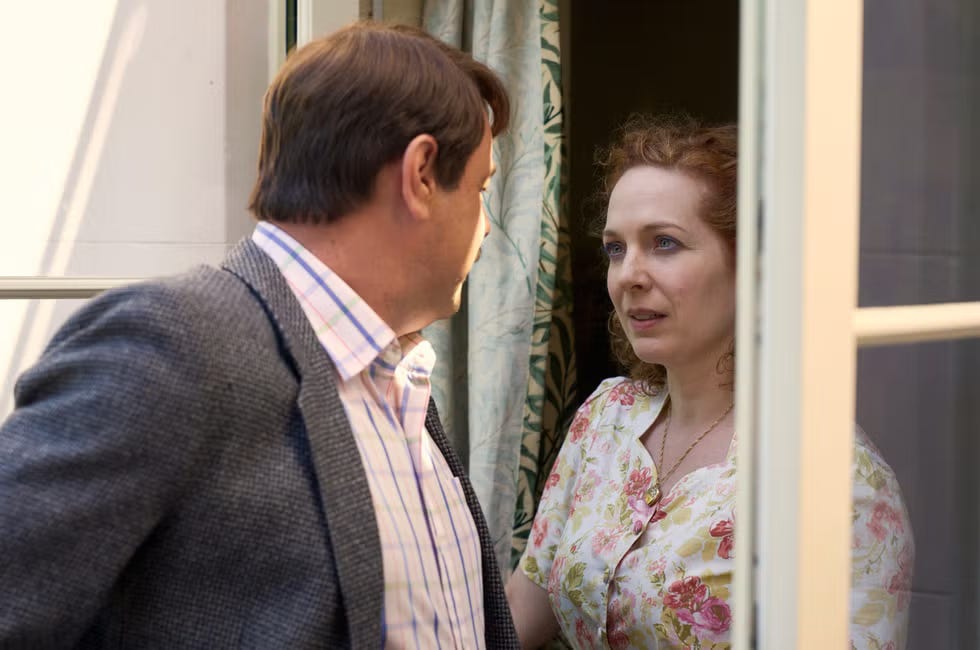
Sarah Dempster’s review is as good at the programme itself. But Ian Patterson who discovered Jilly Cooper when his wife, the writer Jenny Diski, was dying - thinks the adaptation misses the zing of Cooper’s dialogue - and the novel’s essential kindness. “I was won over by the gleeful silliness and the rivalry between the good characters….Leaving the vigorous sex and uber-competitiveness of Rivals aside, what really got me was the spirit of kindness that underlies it all.”
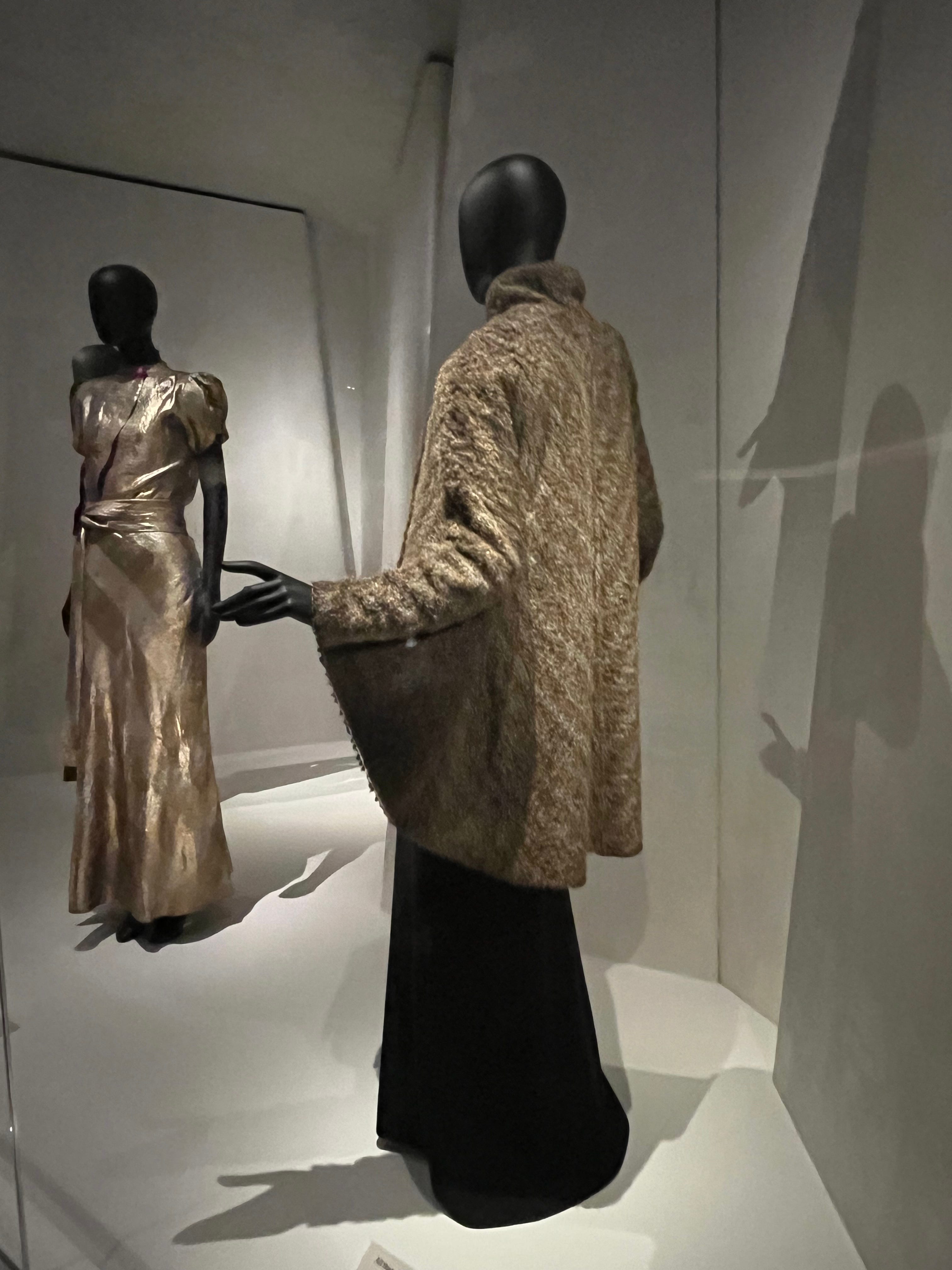
I saw the Schiaparelli exhibition at the V&A as a birthday treat - and Elsa Schiaparellil’s designs are so charming and witty and modern - exposed zips! In the 1930s! She really cut to flatter the female body - no boxy suits here. But why, I demand, do I not have an opera coat in my life? Or indeed a life that requires one?
“Between what happens to us and what we do next, there is a space.” This is a flipping brilliant piece by Philippa Perry. I was talking about this the other day, in the context of one of the best pieces of advice I have been given, which I share with you now: you cannot choose what happens, you can only choose how you react it it. You can recognise that it happened, or you can allow it to define you.
Philippa Perry expresses it far better than I do:
“Terrible things happen and some people are handed far heavier burdens than others. Acknowledging suffering is not self indulgence, it is often the beginning of healing. But there is a difference between recognising what has happened to us and building our identity around it.”
This piece about the lifelong effect of childhood bullying by Daisy Buchanan is one of the bravest thing I have read in a long time - even though reading it made my heart break for little Daisy, who had her childhood stolen by bullies and adults who took too little care.
Also: why Daisy rewrite Little Women.
Stop trying to fix yourself says Toni Jones via Rosamund Dean’s substack. Toni read 1000 self-help books so you don’t have to - you can simply order hers: YOU: The Beginner’s Guide.
School P.E. ruined exercise for Lauren Bravo. I feel this! I have chilling flashbacks to grubby, chilly changing rooms and teachers who barked at you to brandish a hockey stick and “DO NOT RUN AWAY”.
Claire Powell was desperate for a baby, but IVF took a huge toll on her relationship.
Garden designer and all-round gorgeous woman Pollyanna Wilkinson recently wrote about her career pivots (it’s a v good piece and has some excellent advice for would-be garden designers). Point 4 really resonates. (I am writing this on Sunday afternoon, in the garden, next to the Nepeta which I have just Chelsea chopped and stuffed into jugs and vases and jam jars. This task pains me every year: it feels counterintuitive to cut a plant in its prime.
Why we’re still trying to understand Marilyn.

When California cool meets Gallic charm. Claire Vivier’s house in Architectural Digest is exceedingly covetable.
Two of my favourites JP Clark and Jo Thompson in one place - I adored this peek into Jo’s gorgeous garden and home on JP’s heavenly Home+Hort. “A bare wall bothers me to the point of depression.” And her garden transformation is breathtaking. I interviewed her recently and came away determined to stuff my very small plot with plants. You can, she assured the audience, have a journey through even the smallest garden. Of her own, she says:
“I got to where I wanted: a romantic place full of changing plants spotted and dotted and located in the unlikeliest of places. In this cottage garden, memory and nostalgia play a large part in what goes in and what comes out in other gardens: storybook roses and columbines feel as if they belong. Apart from the thorns of the roses, all is soft and tumbling as plants are left to explore where they want to go. Irises have made their way happily under the shade of shrub roses who have climbed into the shade of trees, lots of rule-breaking going on. Plants have their places but they also surprise us, and tolerance is the approach in these beds.”
Didn’t get to RHS Chelsea this year? Read all about it via JP’s report (not what anyone was expecting but all the better for it).
Lisa Dawson is giving us all the courtyard garden inspiration.
100 summer dresses courtesy of the always sartorially wise wearsmymonye aka Kate Hiscox.
I am delighted Ella Risbridger’s The Kitchen Bible is a hit. Ella writes about food (well, anything, to be frank) with such heart and charm. I loved this interview with Ella on India Knight’s perennially excellent Home.
I totally agree with Jessica Fellowes about succumbing to the lure of overpriced coffee when in London.
And Sarah Clark is on Substack and she has exquisite taste as anyone who has followed her since her Little Spree days will know - you can now find her shopping edits here. Warning: not the faint of wallet.
Objects of Delight
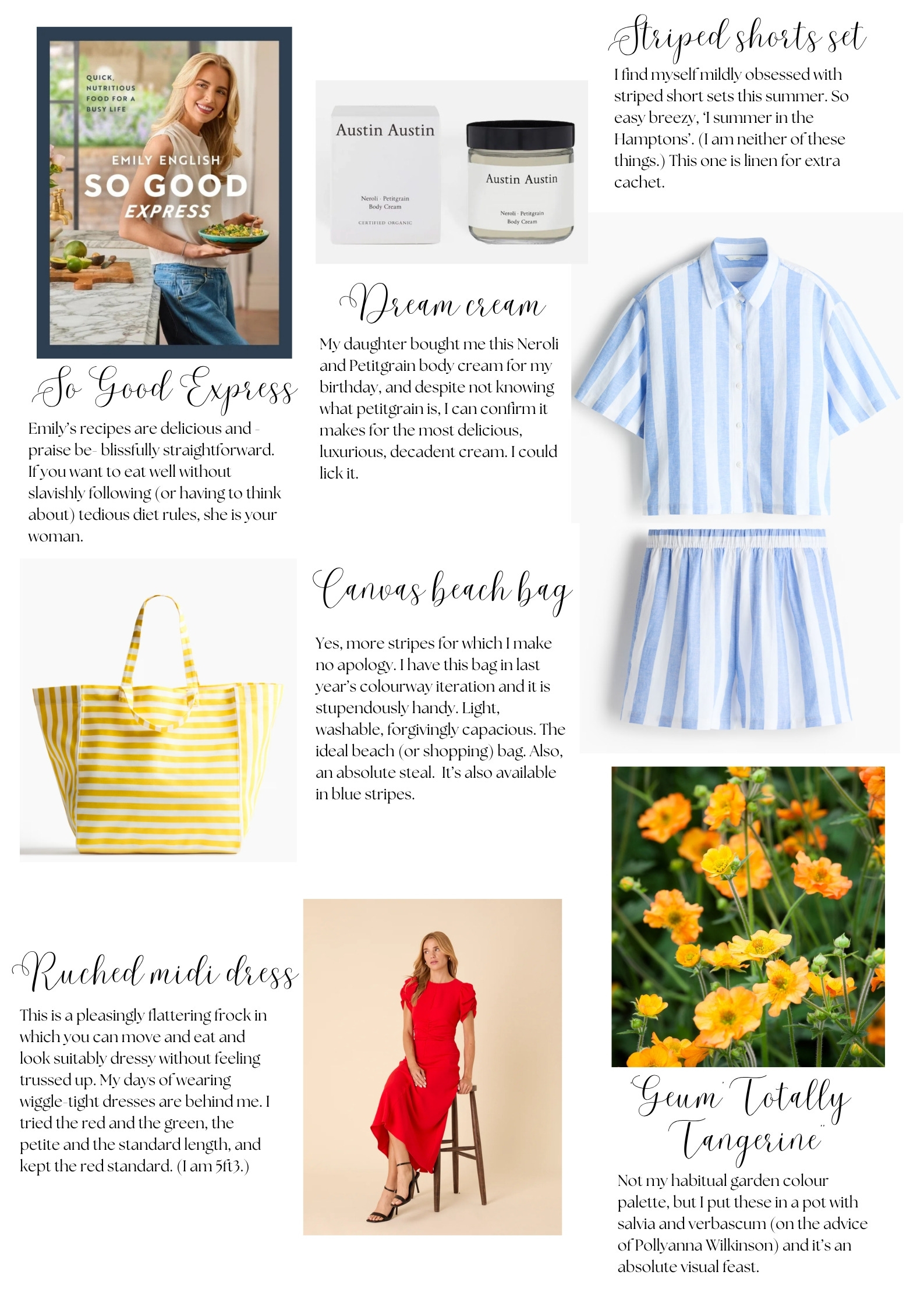
Links: So Good Express; body cream; shirt and shorts; beach bag; Midi dress; geums
And that, my friends, is that. It’s a monster edition, so please may it keep you happy ‘til we meet again. And if it brought you pleasure or intrigued you, or if you have something We Must Talk About, you can drop me a line below or a heart - every heart counts! Or best yet, share it with your Substack community.
Fabulous!! Great selection of books! Your substack is always SO good!! Thank you 😊
What an absolute glut of delights! Also we spent the hot holiday reading the same things -- well Ripeness and Whistler for me, anyway.
I really love how deftly you've written about Ripeness here, and that central internal wrestling in Edith; the way family history resurfaces again and again. MAINLY because I feel like the jacket blurb does such a disservice to the book -- "family secrets in 1960s Italy". Makes it sound like there is going to be a big reveal, which I know publishers have to do this in the era of the instagram/booktok novel but this has never been Sarah Moss's style. She's always been a much subtler writer than that. I couldn't put it down. Tense and tender is exactly how to describe it.
ALSO totally agree re Whistler. I adored it. Did you see that rather mean Guardian review? Would love to know what you made of it, I was just discussing MY THOUGHTS ON WHY IT IS WRONG with someone yday xx
ps. Thanks for mentioning my Guardian Top 100 thingy!